
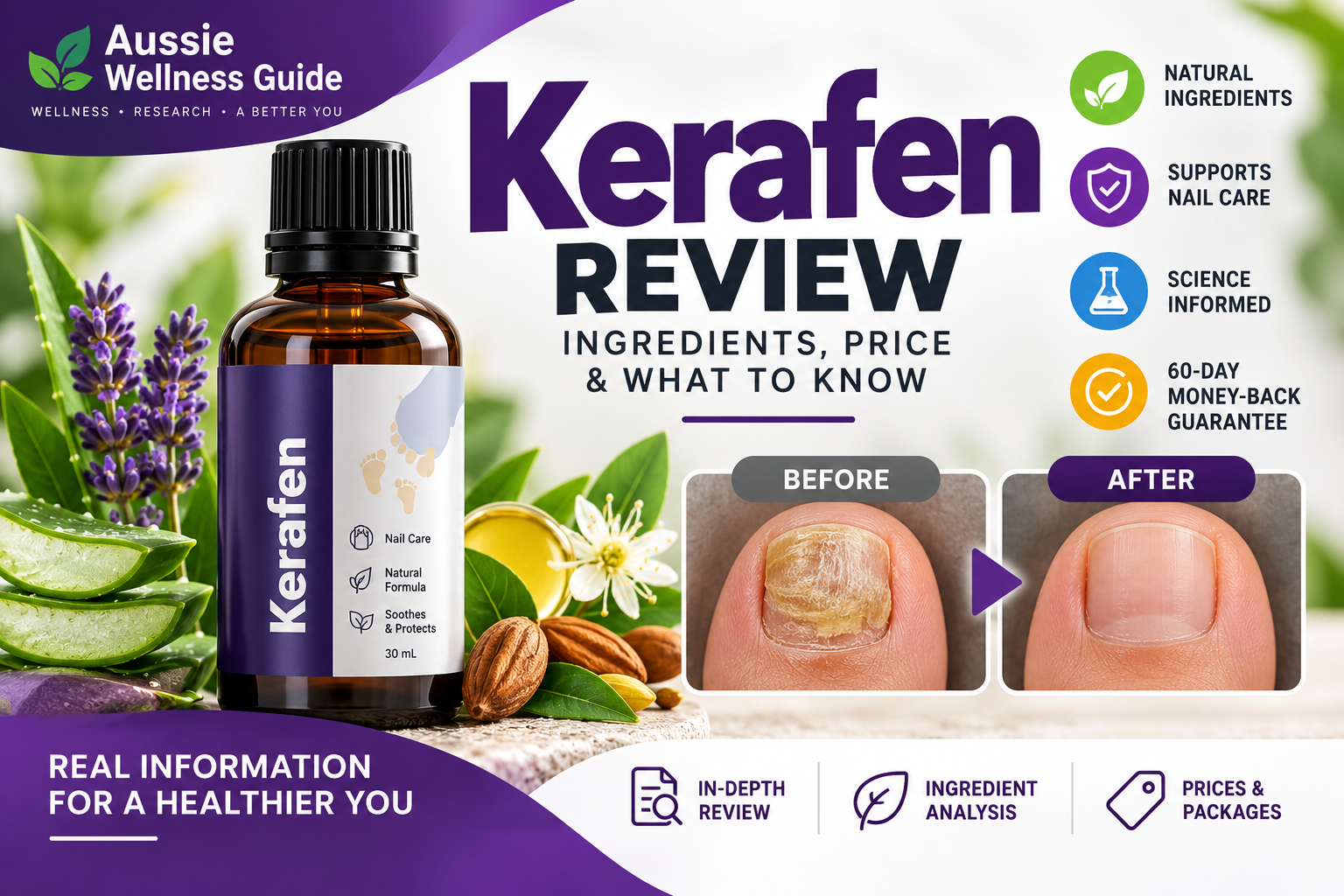
If you are researching topical products for nail and foot care, you may have come across Kerafen, a topical formula marketed around a blend of botanical oils and other ingredients.
The product combines ingredients such as undecylenic acid, tea tree oil, aloe vera, vitamin E and several plant oils. The manufacturer also provides scientific references relating to some of the individual ingredients.
But there is an important distinction to make when evaluating Kerafen: research on an individual ingredient does not automatically demonstrate that the finished Kerafen formula has been clinically proven to produce the same results.
In this Kerafen review, we look at the formula, ingredients, pricing, scientific evidence, package options and other information shoppers may want to consider before purchasing.
What Is Kerafen?
Kerafen is a topical liquid product sold in a small dropper bottle. According to the product information, the formula contains 15 listed ingredients, including undecylenic acid USP, tea tree essential oil, aloe vera, vitamin E and several botanical oils.
The product is marketed primarily around nail and foot care.
The manufacturer describes the formula using strong language related to fungal concerns. However, those statements should be considered manufacturer marketing claims rather than independent clinical evidence of the finished product’s effectiveness.
That distinction is particularly important when evaluating products in the nail-fungus category.
Kerafen Ingredients
The product page lists 15 ingredients:
- Undecylenic Acid USP
- Tea Tree Essential Oil
- Aloe Vera Leaf
- Vitamin E Oil
- Organic Flaxseed Oil
- Walnut Oil
- Menthol
- Camphor Oil
- Clove Bud Essential Oil
- Jojoba Oil
- Chia Oil
- Manuka Oil
- Lemongrass Oil
- Lavender 40/42 Essential Oil
- Sweet Almond Oil
The manufacturer also provides descriptions of various ingredients and links to scientific references.
However, the publicly available product information does not provide enough detail to independently determine the exact amount of every ingredient in the finished formula.
That makes direct comparison with clinical studies more difficult.
1. Undecylenic Acid USP
Undecylenic acid is one of the most important ingredients to examine because it has a history of use in topical antifungal products.
The FDA’s OTC Monograph M005 lists undecylenic acid and certain undecylenate salts among active antifungal ingredients, with a total undecylenate concentration of 10% to 25% for products meeting the applicable monograph conditions.
There is also older clinical research involving undecylenic acid.
For example, a controlled clinical trial involving tinea pedis reported clinical and mycological cures in patients treated with undecylenic acid powder preparations.
Another randomized study compared undecylenic acid/zinc undecylenate with placebo in superficial fungal infections and reported better outcomes for the active treatment.
However, these studies do not establish that Kerafen itself has been clinically proven, and they should not be interpreted as clinical trials of the finished product.
2. Tea Tree Essential Oil
Tea tree oil is another prominent ingredient in Kerafen.
There has been research investigating topical tea tree oil for fungal conditions, including onychomycosis.
One randomized trial compared 100% tea tree oil with 1% clotrimazole for toenail onychomycosis. After six months, culture-confirmed cure was 18% with tea tree oil compared with 11% with clotrimazole, although the differences and overall results do not establish tea tree oil as a proven replacement for standard treatments.
A systematic review of randomized trials concluded that the evidence for tea tree oil was promising but not compelling.
More recent reviews similarly describe the evidence for complementary treatments such as tea tree oil as preliminary and emphasize the need for larger, better-designed trials.
So, while tea tree oil is an interesting ingredient, the research should not be presented as proof that Kerafen treats nail fungus.
3. Aloe Vera and Vitamin E
Kerafen also contains aloe vera leaf and vitamin E.
These ingredients are commonly used in topical cosmetic and skin-care formulations.
The product manufacturer associates them with skin conditioning and moisturizing properties.
However, their presence in Kerafen does not establish that they have a therapeutic effect against nail fungus.
4. Botanical Oils and Other Ingredients
The remaining formula includes:
- Flaxseed oil
- Walnut oil
- Menthol
- Camphor oil
- Clove bud essential oil
- Jojoba oil
- Chia oil
- Manuka oil
- Lemongrass oil
- Lavender essential oil
- Sweet almond oil
These ingredients give Kerafen a relatively complex botanical formula.
Some have been investigated for antimicrobial, cosmetic or skin-related properties, but the existence of laboratory or ingredient-level research is not equivalent to clinical evidence for the finished Kerafen product.
This is one of the most important points to keep in mind when reading the scientific references presented on the product website.
What Does the Scientific Evidence Actually Show?
This is where a careful Kerafen review needs to go beyond the sales page.
For general information about fungal nail infections, the American Academy of Dermatology provides an overview of symptoms, diagnosis and treatment options.
There is scientific literature concerning several ingredients used in the formula.
For example:
- undecylenic acid has been investigated in controlled studies of superficial fungal infections;
- tea tree oil has been studied for fungal skin and nail conditions;
- scientific reviews have examined complementary treatments for onychomycosis.
However, a systematic review of topical treatments found that the evidence for nail infections was considerably less convincing than the evidence for fungal infections of the skin.
There is also an important regulatory consideration.
The FDA’s current OTC antifungal monograph states that products must satisfy the applicable conditions of the monograph to be considered generally recognized as safe and effective under that framework.
The FDA has also stated in a 2026 warning letter that topical antifungal products labeled with claims or directions for use on the nails are not considered GRASE under the relevant determination.
Therefore, shoppers should not interpret the presence of an FDA-listed ingredient as FDA approval of Kerafen.
We also did not identify a published randomized clinical trial demonstrating that the finished Kerafen product is effective for toenail fungus.
That is an important limitation.
How Do You Use Kerafen?
The manufacturer markets Kerafen as a topical product applied directly to the affected area.
Because application instructions can change between product versions, shoppers should follow the current instructions provided with the product they receive rather than relying exclusively on information from an older review.
It is also worth remembering that changes in nail appearance can have several causes. A discolored, thickened or damaged toenail is not automatically caused by a fungal infection.
Anyone uncertain about the cause of a nail problem may want to speak with a qualified healthcare professional before relying on a topical product.
Kerafen Price and Packages
| Package | Supply | Price per Bottle | Total |
|---|---|---|---|
| 2 Bottles | 60 days | $79 | $158 |
| 3 Bottles | 90 days | $59 | $177 |
| 6 Bottles | 180 days | $49 | $294 |
The BuyGoods offer associated with this review provides Kerafen through an affiliate sales funnel.
The offer information indicates a one-time purchase, rather than an automatic recurring subscription.
Pricing and package availability can change, so buyers should check the current checkout page before ordering.
The offer also advertises a 60-day money-back guarantee.
For the most accurate current price, package options and shipping information, it is best to review the current offer page at the time of purchase.
Is Kerafen a One-Time Purchase?
Based on the offer information available for this review, Kerafen is presented as a one-time purchase.
That can be an advantage for shoppers who prefer not to enroll in an automatic recurring shipment.
However, it is always sensible to verify the final checkout details before completing an order, particularly because affiliate offers and package pricing can change.
What About Kerafen Reviews?
The Kerafen sales page includes customer testimonials and statements describing positive experiences.
These testimonials may be useful for understanding how individual customers describe their experiences, but they should not be treated as scientific evidence.
Individual testimonials also cannot establish how typical a result may be for the broader customer population.
For that reason, we would place more weight on the ingredients, available research and limitations of the evidence than on individual testimonials.
Pros and Cons of Kerafen
Pros
- Contains a relatively extensive 15-ingredient formula.
- Includes undecylenic acid, an ingredient with historical antifungal research.
- Contains tea tree oil, which has been investigated in clinical studies.
- Includes several botanical oils and skin-conditioning ingredients.
- Available through an established affiliate marketplace.
- Offer includes a 60-day money-back guarantee.
- Presented as a one-time purchase.
Cons
- Individual ingredient quantities are not clearly disclosed in the publicly available information reviewed.
- We did not identify a published clinical trial of the finished Kerafen formula.
- Evidence for topical treatments of nail fungus is more complicated than evidence for superficial skin fungal infections.
- Some marketing claims are stronger than the available independent evidence.
- Product claims involving nail fungus should be interpreted cautiously.
- Pricing and package options can change.
Who May Want to Consider Kerafen?
Kerafen may be of interest to shoppers who are specifically researching topical nail and foot-care products and want to examine a formula containing both an antifungal-related ingredient and several botanical ingredients.
However, it may not be appropriate for everyone.
People with diabetes, circulation problems, significant nail damage, pain, swelling, spreading redness or a persistent nail problem should consider discussing the condition with a healthcare professional.
It is also important to remember that not every abnormal-looking nail is caused by fungus.
Kerafen FAQ
Is Kerafen FDA approved?
We did not find evidence that Kerafen itself has been approved by the FDA.
The FDA does list undecylenic acid among active ingredients in its OTC antifungal monograph, but this does not mean that Kerafen is FDA-approved.
Does Kerafen contain undecylenic acid?
Yes. Undecylenic Acid USP is listed as one of the ingredients in the Kerafen formula.
Does Kerafen contain tea tree oil?
Yes. Tea Tree Essential Oil is listed in the formula.
Has Kerafen been clinically tested?
We did not identify a published randomized clinical trial specifically testing the finished Kerafen product.
There is research on some individual ingredients, but ingredient research should not be confused with clinical evidence for the complete formula.
How long does Kerafen take to work?
There is not enough independent clinical evidence to establish a specific timeframe for Kerafen.
Nail growth is naturally slow, and changes in nail appearance can take time even when the underlying problem is being appropriately addressed.
Does Kerafen contain natural ingredients?
The formula contains numerous botanical oils and plant-derived ingredients. However, the product also contains ingredients such as undecylenic acid and menthol, so it is more accurate to describe it as a multi-ingredient topical formula rather than simply calling it a natural product.
Is Kerafen a subscription?
The BuyGoods offer reviewed for this article presents Kerafen as a one-time purchase. Buyers should verify the final checkout terms before ordering.
Final Thoughts: Is Kerafen Worth Considering?
Kerafen is an interesting topical formula because it combines undecylenic acid with tea tree oil, botanical oils, aloe vera, vitamin E and other ingredients.
There is legitimate scientific literature concerning some of these individual ingredients. Undecylenic acid, for example, has been studied in superficial fungal infections, while tea tree oil has been investigated for fungal skin and nail conditions.
At the same time, we did not find clinical evidence showing that the finished Kerafen product itself has been proven effective for toenail fungus.
That distinction is important.
For shoppers considering Kerafen, the most reasonable approach is to look at the actual formula, understand what the available research does and does not show, review the current price and guarantee, and avoid assuming that strong marketing claims are equivalent to clinical proof.
Where to Find Kerafen
Kerafen is currently available through the BuyGoods offer associated with this review.
Current Kerafen package options and pricing
Prices, package options, shipping terms and availability may change, so check the current checkout page before purchasing.
Explore more Product Reviews on Aussie Wellness Guide.
Affiliate Disclosure
This article contains an affiliate link. If you purchase Kerafen through our link, Aussie Wellness Guide may receive a commission at no additional cost to you.
Our goal is to provide useful and balanced information so readers can make more informed purchasing decisions. Product information, pricing and availability may change over time, and readers should verify the latest details directly with the seller before purchasing.
Leave a Reply