
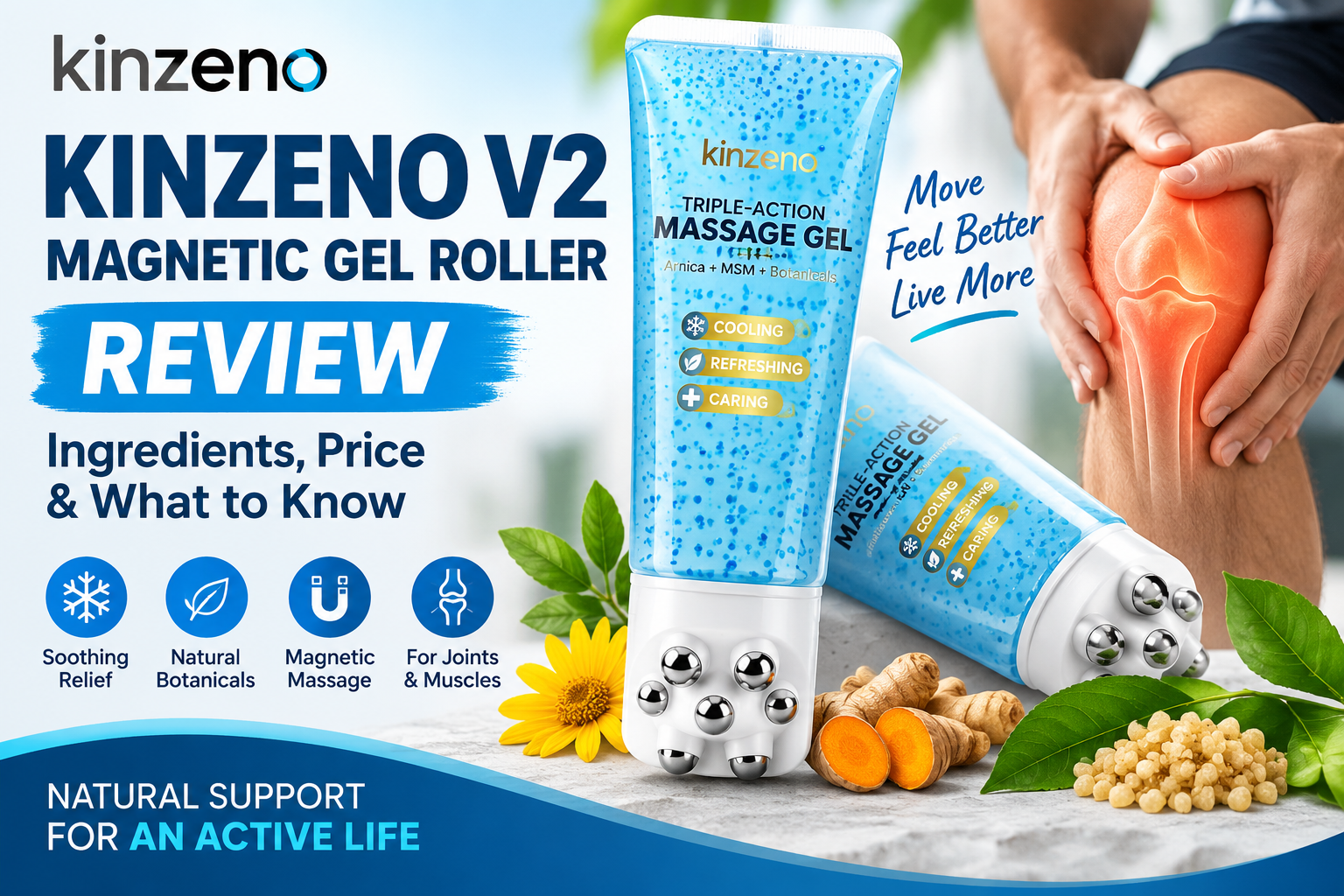
If you are researching topical products for joint and muscle comfort, you may have come across the Kinzeno V2 Magnetic Gel Roller.
In this Kinzeno V2 Magnetic Gel Roller Review, we take a closer look at how the product is designed, its ingredients, magnetic roller system, pricing, customer feedback, safety information, return policy, and the research related to some of its ingredients.
Kinzeno is a topical massage gel combined with a roller applicator. The company markets it around massage, cooling sensations, botanical ingredients, and a magnetic roller system designed to be used over areas of the body where people commonly experience tension or discomfort.
The product page describes the roller as having five neodymium roller balls and a 360-degree rolling system, while the ingredient list includes substances such as MSM, menthol, magnesium compounds, arnica, frankincense oil, allantoin, vitamin E, and several vitamins and botanical components.
But how much of the marketing is supported by available evidence?
Let’s take a closer look.
What Is Kinzeno V2 Magnetic Gel Roller?
Kinzeno V2 Magnetic Gel Roller is a topical massage product intended for external use.
Unlike a conventional cream or gel that is simply rubbed onto the skin by hand, Kinzeno combines the gel with a roller applicator. The company’s product page describes five roller balls inspired by Shiatsu-style massage and a freely rotating roller system designed to reach different areas of the body.
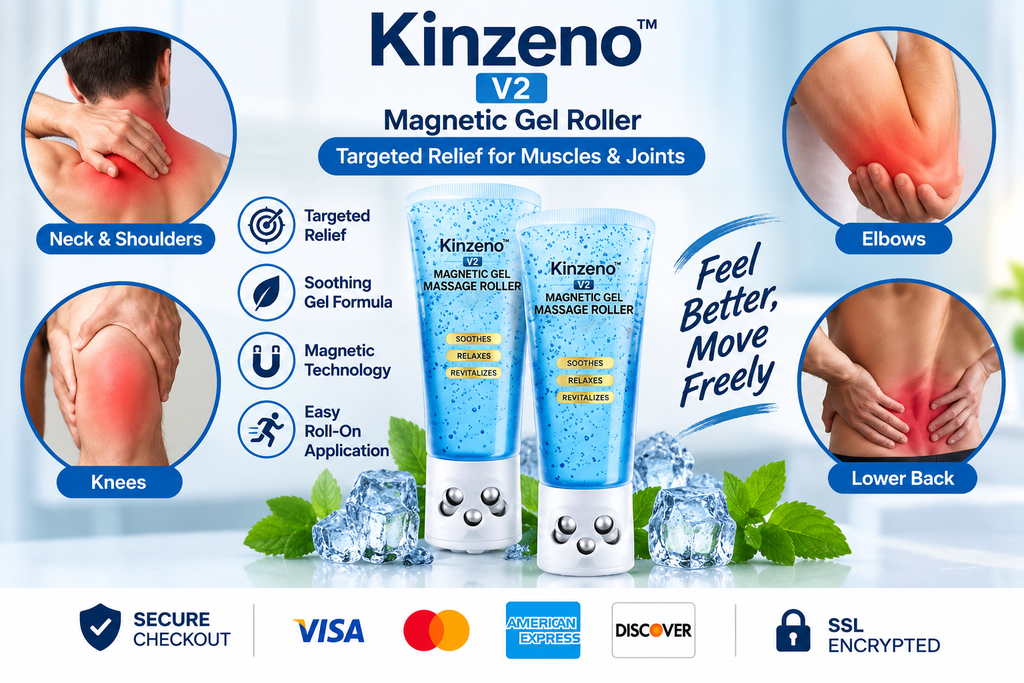
The product is presented for use on areas such as the knees, lower back, shoulders, neck, hands, wrists, feet, ankles, arms, elbows, and fingers. The company’s support documentation states that the gel is intended to be part of a massage routine rather than a treatment for a specific disease or condition.
If you’re comparing wellness supplements, you may also want to read ourArthryon Review, where we take a closer look at its ingredients, pricing, and available information.
The product page also highlights a magnetic component. According to Kinzeno, the roller contains five neodymium magnetic balls and is designed to create a magnetic field during use.
This is worth examining carefully because different types of magnetic therapies have very different evidence bases.
How Does Kinzeno V2 Magnetic Gel Roller Work?
Kinzeno’s approach combines three main elements:
Topical gel
Massage through a rolling applicator
Static magnets incorporated into the roller
The company describes the five roller balls as providing a massage inspired by Shiatsu and says the roller can move through a 360-degree range.
The gel itself contains ingredients associated with cooling, skin conditioning, botanical extracts, and massage-related comfort.
One of the most noticeable ingredients is menthol, which is widely used in topical products that create a cooling sensation. A randomized study of a menthol-based topical analgesic found increased pressure-pain thresholds after application, although the study was small and focused on a topical analgesic rather than the Kinzeno formula itself.
The magnetic component is different.
Kinzeno uses permanent magnets rather than an electrically powered electromagnetic device. According to NCCIH, the evidence for static magnets and pain relief remains inconclusive, while electromagnetic therapies such as PEMF are a different category that has been studied separately.
So the massage and cooling sensation can be discussed separately from the claim that the magnets provide a therapeutic effect.
Kinzeno V2 Magnetic Gel Roller Ingredients
The official Kinzeno ingredient list contains a relatively long list of components.
Among the ingredients specifically highlighted in the company’s product materials are:
- Arnica
- Boswellia or frankincense oil
- Turmeric
- White turmeric
- Ginger
- Panax ginseng
- MSM
- Magnesium
- Menthol
- Allantoin
- Vitamin E
- Moringa
- B-vitamin complex
- Betaine
- Mannitol
The official support page provides the complete ingredient list, which also includes water, propylene glycol, butylene glycol, dimethyl sulfone, betaine, menthol, magnesium sulfate, magnesium chloride, allantoin, arnica flower extract, tocopheryl acetate, frankincense oil, and several vitamin-related compounds.
Importantly, the product materials do not provide individual amounts for these ingredients. That means we can discuss what is included in the formulation, but we should not assume that the quantities match those used in clinical research.
Arnica
Arnica is a botanical ingredient traditionally used in topical products for bruising and muscle discomfort.
There has been some human research into topical arnica. One randomized, double-blind, placebo-controlled trial involving 53 participants examined topical Arnica montana cream after calf-raise exercise. The study measured pain, tenderness, and range of motion.
Another randomized trial in trained men found that topical arnica was associated with less muscle tenderness and pain at one later time point after strenuous exercise, although it did not improve performance or several biological markers of muscle damage or inflammation.
These findings provide some context for why arnica appears in topical products, but they do not establish that the arnica concentration in Kinzeno produces the same results.
Boswellia
Kinzeno’s ingredient list includes Boswellia carterii oil, also known as frankincense oil.
Boswellia has been studied in relation to osteoarthritis and joint symptoms, although much of the clinical literature involves oral Boswellia extracts, not necessarily topical frankincense oil.
A systematic review and meta-analysis of randomized trials involving Boswellia and osteoarthritis found improvements in measures such as pain, stiffness, and function compared with control groups.
That research is interesting, but it should not be treated as direct evidence for topical Kinzeno.
The form, concentration, route of administration, and formulation are all different factors.
Turmeric
Turmeric is another botanical highlighted by Kinzeno.
Research involving turmeric and curcumin has examined pain and osteoarthritis, including topical formulations.
A 2026 randomized, double-blind, placebo-controlled study of a topical curcumin gel involved 60 adults with knee osteoarthritis. Participants used the product every other day for 28 days, and the curcumin group showed greater improvement in one primary pain measure than placebo. The researchers also reported that the formulation was generally well tolerated, although temporary skin staining occurred.
This is useful evidence for the general concept of topical curcumin, but the study used a specific formulation called VAS-101, not Kinzeno.
Therefore, the study cannot be used to claim that Kinzeno produces the same effect.
Ginger
Kinzeno also highlights ginger as part of its botanical formula.
Topical ginger has been studied in adults with osteoarthritis. One small study involving 20 adults evaluated ginger compresses and standardized ginger patches. The researchers reported improvements in several symptom measures after one week, but the study was small.
A later systematic review and meta-analysis concluded that the evidence surrounding ginger for knee osteoarthritis was heterogeneous and that topical ginger did not show statistically significant differences in the comparisons analyzed.
That means ginger is a researched botanical, but the existing evidence does not establish a predictable effect from the amount contained in Kinzeno.
MSM
MSM, or methylsulfonylmethane, is another component highlighted by the manufacturer.
MSM has been studied in osteoarthritis, including randomized controlled trials involving oral supplementation.
For example, a controlled trial involving 49 participants with knee osteoarthritis evaluated MSM at 1.125 grams three times daily for 12 weeks.
That is a much different exposure from a topical gel whose precise MSM concentration is not disclosed.
For that reason, research on oral MSM should be treated as supporting background evidence rather than proof of Kinzeno’s effectiveness.
Magnesium
Kinzeno contains magnesium sulfate and magnesium chloride, according to its official ingredient list.
Magnesium is an essential mineral, but research involving topical magnesium has focused on different applications.
For example, systematic reviews have examined topical magnesium in the prevention of postoperative sore throat, rather than joint or muscle pain.
This illustrates another important point when evaluating topical formulas: evidence for an ingredient in one application does not automatically demonstrate an effect for a different application.
Menthol
Menthol is one of the most familiar ingredients in topical comfort products.
Its cooling sensation is well established, and research has investigated menthol-containing topical products for temporary changes in pain sensitivity.
In one randomized trial involving 16 participants, a menthol-based topical analgesic increased pressure-pain thresholds after application.
That supports the idea that menthol can influence the sensation associated with topical application, but it does not demonstrate that Kinzeno treats an underlying medical condition.
Allantoin
Allantoin is included in the official ingredient list and is commonly used in topical cosmetic formulations for skin conditioning.
Kinzeno’s product materials describe allantoin as an ingredient intended to soothe and protect irritated skin.
It is more appropriate to view allantoin as a skin-care component of the formulation rather than as evidence of a clinical effect on joint or muscle disease.
Vitamin E
The official ingredient list includes tocopheryl acetate, a form of vitamin E.
Vitamin E compounds are widely used in cosmetic and topical formulations, particularly because of their role as antioxidants.
However, the presence of vitamin E in Kinzeno does not establish that the gel improves joint or muscle symptoms.
Panax Ginseng, Moringa and Other Botanicals
The product page also highlights Panax ginseng, moringa, white turmeric, betaine, a B-vitamin complex, and other components.
Some of these ingredients have been studied in traditional medicine, nutritional science, or laboratory research, but evidence for topical use in a product like Kinzeno is much more limited.
The safest way to describe them is as ingredients included in the manufacturer’s formulation, rather than assuming that each provides a specific therapeutic effect.
What Does the Kinzeno Magnetic Roller Do?
The roller is one of the defining features of the product.
Kinzeno describes five roller balls inspired by Shiatsu-style massage and says the roller rotates freely through a 360-degree range.
Massage itself can provide temporary changes in comfort and perceived muscle tension, and the physical roller can make the product easier to apply consistently.
However, the magnetic component requires more caution.
NCCIH explains that static magnets are different from electromagnetic therapies. According to its current evidence summary, there is no conclusive evidence that static magnets are effective for pain relief.
A 2026 systematic review also found that evidence for certain electromagnetic therapies is mixed and should not be generalized to all magnetic devices.
Therefore, it would be inaccurate to state that Kinzeno’s magnets have been clinically proven to relieve pain.
A more accurate description is that Kinzeno combines a massage roller with static magnets, while the specific therapeutic benefit of the magnets themselves remains uncertain.
Does Kinzeno V2 Magnetic Gel Roller Really Work?
This is perhaps the most important question in a Kinzeno V2 Magnetic Gel Roller Review.
The answer depends on what part of the product we are discussing.
The massage experience is straightforward: the roller physically massages the skin and underlying soft tissues, while the gel provides topical ingredients and a cooling sensation.
Menthol has some research supporting temporary changes in pain sensitivity, and there is limited evidence for certain topical botanical ingredients.
However, the evidence is less convincing for the static magnetic component.
NCCIH states that there is no conclusive evidence that static magnets provide pain relief.
Most importantly, we did not identify a high-quality randomized clinical trial demonstrating that the complete Kinzeno V2 Magnetic Gel Roller formula and roller system treats joint pain, sciatica, arthritis, or another medical condition.
That means individual ingredients and features should be considered separately from claims about the complete product.
Kinzeno V2 Magnetic Gel Roller Price
During our checkout verification, the One-Time Purchase option displayed four package choices:
| Package | Price per package | Product total |
|---|---|---|
| 4x Kinzeno Magnetic | $29.99 | $119.96 |
| 3x Kinzeno Magnetic | $35.99 | $107.97 |
| 2x Kinzeno Magnetic | $44.99 | $89.98 |
| 1x Kinzeno Magnetic | $49.99 | $49.99 |
The checkout showed:
Standard U.S. shipping: $8.95
The checkout also displayed a separate Subscribe & Save option, so shoppers should make sure that One-Time Purchase is selected if they do not want recurring billing.
The final total can also vary depending on shipping, taxes, promotions, and the selected package.
Subscription vs. One-Time Purchase
This is an important detail when ordering Kinzeno.
The checkout offers both:
One-Time Purchase
and
Subscribe & Save
Under the subscription option, the checkout states that the customer is billed on a recurring monthly basis until cancellation.
The One-Time Purchase prices we verified are therefore separate from the subscription prices.
Before completing an order, consumers should carefully check which purchasing option is selected and review the final total.
This is particularly important because the lower displayed price under a subscription offer can look attractive compared with the one-time price.
Kinzeno Reviews: What Are Customers Saying?
The Kinzeno sales materials contain multiple customer testimonials and display claims about customer satisfaction.
Those testimonials are useful as examples of individual customer experiences, but they are not equivalent to controlled clinical evidence.
For example, a customer may report that a product felt soothing or that massage became more comfortable, but that does not establish how frequently other customers experience the same outcome.
Kinzeno’s sales materials also use promotional statements about relief, movement, and comfort. These should be understood as marketing claims from the manufacturer, rather than independent medical conclusions.
A review article should therefore keep three things separate:
What the company says
What customers report
What independent scientific research demonstrates
Those categories are not interchangeable.
Kinzeno V2 Magnetic Gel Roller Side Effects & Safety
Kinzeno is intended for external use only.
The manufacturer’s support documentation says not to ingest the product, to avoid contact with the eyes and mucous membranes, and to rinse thoroughly with water if irritation occurs. It also advises stopping use in cases of irritation.
The support documentation also recommends keeping the product out of reach of children.
Because the formula contains multiple botanical and topical ingredients, people with sensitive skin may want to exercise additional caution when trying a new topical product.
A small patch test can be a practical way to check how the skin reacts before applying a larger amount, although this does not eliminate the possibility of irritation.
Important: Magnets and Medical Devices
The magnetic component deserves additional attention.
NCCIH states that magnetic devices may interfere with certain implanted medical devices, including pacemakers and insulin pumps. It also advises removing magnetic devices before MRI procedures.
Because Kinzeno uses permanent magnets in its roller, people with implanted electronic or magnetic-sensitive medical devices should discuss its use with their healthcare provider before using it.
Kinzeno should also not be used as a reason to delay medical evaluation of persistent or unexplained pain. NCCIH specifically advises against using magnets as a replacement for conventional medical care.
How to Use Kinzeno
Kinzeno’s official instructions recommend applying approximately a coin-sized amount of gel to the desired area and gently massaging it in circular movements.
The company recommends allowing the product to remain on the area for around 15 to 20 minutes before washing or covering the area.
The stated usage frequency is two to three times daily or as needed.
The manufacturer also lists several areas where Kinzeno can be applied, including shoulders, knees, lower back, neck, hands and wrists, feet and ankles, arms and elbows, and fingers.
Consumers should follow the current instructions that come with the product.
Kinzeno 60-Day Return Policy
Kinzeno currently advertises a 60-day return policy for physical products purchased through its website. The official policy states that customers can request a return within 60 days of receiving the product in situations including damaged products, defective products, wrong items, or simply changing their mind.
The policy requires customers to contact support before sending the product back and obtain a return authorization.
There are also specific conditions regarding the condition of returned items and tracking information.
One important detail is that shipping costs are not refundable according to the official return policy.
The company states that approved refunds are issued after the returned package has been received and inspected.
Consumers should always check the current policy before ordering because return conditions can change.
Is Kinzeno V2 Magnetic Gel Roller FDA Approved?
Kinzeno is marketed as a topical massage gel and is not presented as an FDA-approved prescription treatment.
The product page itself states that Kinzeno is not intended to diagnose, treat, cure, or prevent a specific disease or condition.
This distinction matters.
A product can contain ingredients with scientific research behind them without being an FDA-approved treatment for arthritis, sciatica, joint pain, or another medical condition.
Similarly, evidence for a particular ingredient does not mean the finished Kinzeno product has been approved or clinically validated for the same purpose.
Consumers should therefore view Kinzeno as a topical massage and wellness product, not as a replacement for professional medical diagnosis or treatment.
Where to Buy Kinzeno V2 Magnetic Gel Roller
The Kinzeno V2 Magnetic Gel Roller is sold online through the Kinzeno offer page.
During our checkout test, the product offered a One-Time Purchase option with packages ranging from one to four units.
The prices we verified were:
1 unit: $49.99
2 units: $89.98
3 units: $107.97
4 units: $119.96
Standard shipping was shown as $8.95 during our checkout test.
The offer also contained a subscription option, so shoppers should verify the purchase type before submitting payment.
Pricing and promotions may change.
CHECK CURRENT KINZENO V2 MAGNETIC GEL ROLLER PRICE
Kinzeno V2 Magnetic Gel Roller Pros and Cons
Potential Advantages
Kinzeno combines a topical massage gel with a roller applicator, which may make application convenient.
The formula includes several recognizable topical ingredients, including menthol, arnica, MSM, magnesium compounds, allantoin, and vitamin E.
Some individual ingredients have been investigated in human research involving pain, osteoarthritis symptoms, or topical use, although the evidence varies considerably between ingredients.
The product is also available through a one-time purchase option, giving customers an alternative to the recurring subscription.
Finally, Kinzeno provides a 60-day return policy for qualifying physical-product purchases made through its website.
Potential Concerns
The biggest limitation is the lack of a high-quality clinical trial demonstrating that the complete Kinzeno V2 Magnetic Gel Roller treats a specific medical condition.
The product also contains permanent magnets, while the evidence for static magnets and pain relief remains inconclusive.
Another limitation is that the individual quantities of the many ingredients are not disclosed on the official ingredient list we reviewed.
That makes it difficult to compare the actual exposure from Kinzeno with doses used in scientific studies.
Finally, people with certain implanted medical devices need to be particularly careful with magnetic products because magnets can interfere with some devices.
Kinzeno V2 Magnetic Gel Roller Review: Our Takeaway
This Kinzeno V2 Magnetic Gel Roller Review found a product that combines a topical gel, massage roller, multiple botanical and cosmetic ingredients, and five permanent magnets.
The formulation includes ingredients that have been studied in different contexts.
Arnica has been investigated for topical muscle discomfort, Boswellia has been studied largely in oral osteoarthritis research, ginger has been examined in topical and oral applications, and menthol has evidence for altering pain sensitivity when applied topically.
However, the evidence should not be stretched beyond what the studies actually tested.
A study involving an oral Boswellia extract is not the same as using Boswellia oil in a topical gel.
A study using a specific topical curcumin formulation is not the same as using turmeric in Kinzeno.
And evidence involving electromagnetic therapy should not automatically be applied to a consumer roller containing static magnets.
For these reasons, Kinzeno is best viewed as a topical massage product with cooling and botanical ingredients, rather than a clinically established treatment for a specific pain condition.
Frequently Asked Questions
What is Kinzeno V2 Magnetic Gel Roller?
Kinzeno V2 Magnetic Gel Roller is a topical massage gel combined with a roller applicator. The company describes the roller as using five neodymium magnetic balls and a 360-degree rolling system.
What ingredients are in Kinzeno?
The official ingredient list includes water, propylene glycol, butylene glycol, MSM, menthol, magnesium sulfate, magnesium chloride, allantoin, arnica flower extract, frankincense oil, tocopheryl acetate, and several vitamin and botanical components.
Does Kinzeno contain magnets?
Yes. The manufacturer states that the roller contains five neodymium magnetic balls.
Does Kinzeno use static or electromagnetic therapy?
Kinzeno uses permanent magnets incorporated into the roller. This is different from powered electromagnetic therapies such as PEMF. NCCIH notes that evidence for static magnets and pain relief is not conclusive.
How do you use Kinzeno?
The manufacturer recommends applying about a coin-sized amount to the desired area, massaging gently in circular movements, allowing it to remain on the skin for 15 to 20 minutes, and reapplying two to three times daily or as needed.
Where can Kinzeno be applied?
The manufacturer’s support information lists areas including the shoulders, knees, lower back, neck, hands, wrists, feet, ankles, arms, elbows, and fingers.
How much does Kinzeno cost?
During our checkout verification, one-time purchase prices were $49.99 for one unit, $89.98 for two, $107.97 for three, and $119.96 for four units, plus $8.95 standard shipping.
Is Kinzeno a subscription?
The checkout provides both a One-Time Purchase and Subscribe & Save option. The subscription is recurring, so shoppers should verify the selected purchase type before completing payment.
Does Kinzeno have a guarantee?
Kinzeno’s official website provides a 60-day return policy for qualifying physical-product purchases. Shipping costs are not refundable under the stated policy.
Can I use Kinzeno if I have a pacemaker?
Because Kinzeno contains permanent magnets, people with pacemakers or other implanted medical devices that may be affected by magnets should consult their healthcare provider before using it. NCCIH notes that magnets can interfere with some medical devices.
Is Kinzeno safe to use on the skin?
Kinzeno’s support documentation says it is intended for external use only, advises avoiding the eyes and mucous membranes, and recommends rinsing with water and stopping use if irritation occurs.
Is Kinzeno FDA approved?
Kinzeno is not presented as an FDA-approved medical treatment. The company’s own materials state that the product is not intended to diagnose, treat, cure, or prevent a disease or condition.
Final Thoughts
This Kinzeno V2 Magnetic Gel Roller Review highlights a product that combines several familiar topical ingredients with a massage roller and permanent magnets.
The ingredient list is extensive, including menthol, arnica, MSM, magnesium compounds, frankincense oil, allantoin, vitamin E, ginger, turmeric-related ingredients, and other botanical and vitamin components.
Some of those ingredients have been studied individually, but the scientific evidence varies and the exact concentrations in Kinzeno are not disclosed.
The magnetic component deserves particular caution. The manufacturer promotes the five neodymium magnets as part of the product’s design, but current evidence does not establish static magnets as a proven treatment for pain.
For consumers considering Kinzeno, the most useful approach is to understand that it is a topical massage and wellness product, follow the external-use instructions, check for possible magnetic-device concerns, and review the current purchase and return terms before ordering.
During our checkout test, the one-time purchase option ranged from $49.99 for one unit to $119.96 for four units, with $8.95 standard shipping.
Leave a Reply